
Picture a traditional math class: students seated at desks, pencils moving in notebooks,
following along as a teacher works through problems at the front of the room. It’s a
scene that has played out in math classrooms for generations. But according to
research by Dr. Peter Liljedahl, author of Building Thinking Classrooms in Mathematics,
that familiar setup may actually be the workspace least conducive to real student
thinking — encouraging students to mimic rather than reason.
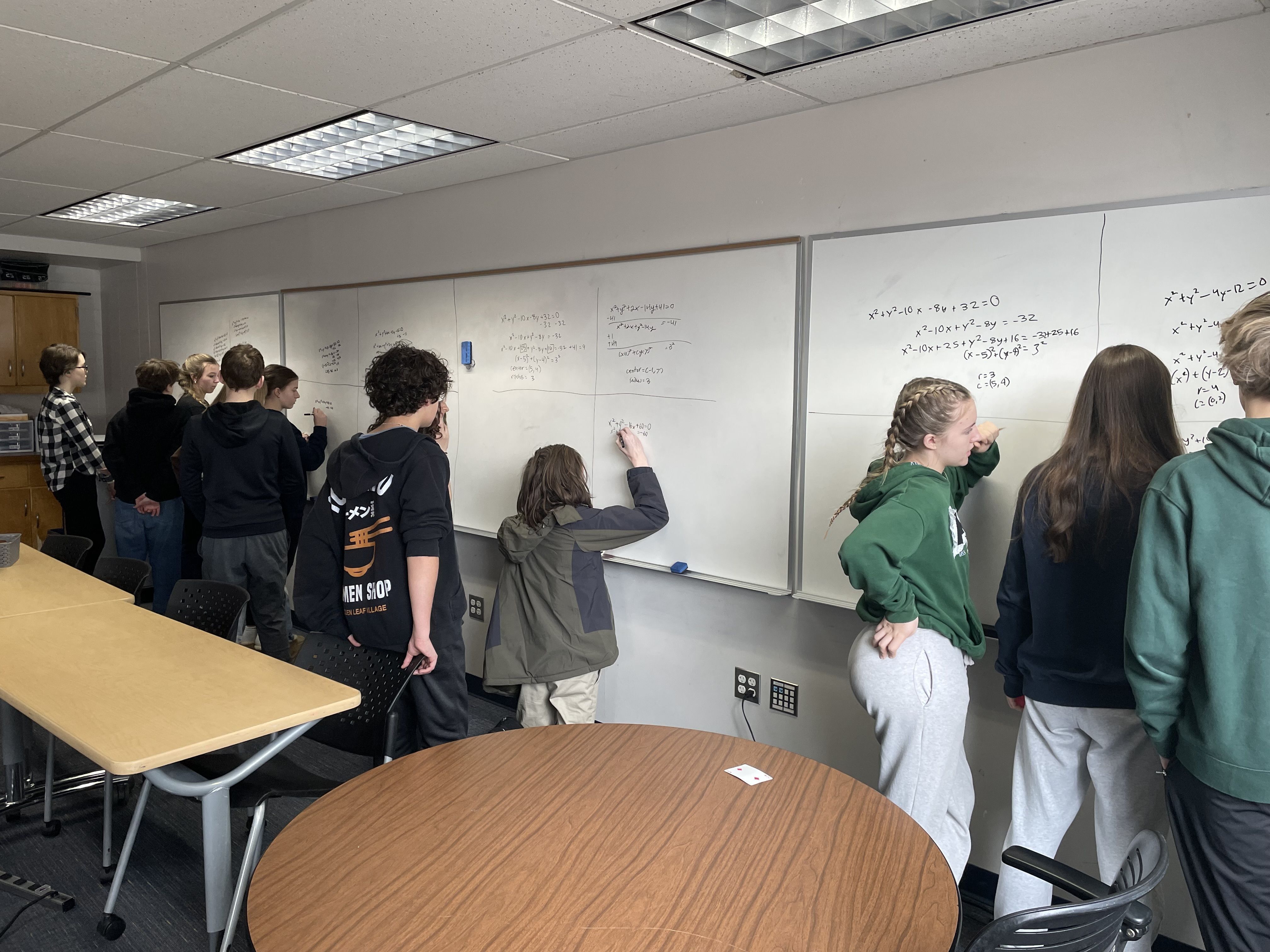
What works better? Getting students on their feet. Liljedahl’s research found that
students working in small random groups at vertical non-permanent surfaces — think
whiteboards on the wall — think more deeply, take more risks, and stay more engaged.
The non-permanent surface lowers the stakes of being wrong, and standing up keeps
students from tuning out.
A grant from the EGR Schools Foundation has given math teacher Cole Hook the
supplies to bring this approach to life in his own classroom — joining colleagues across
the EGR math team who have pursued the same goal over the past several years.
Hook experienced the method firsthand at a professional conference and describes it as
game-changing for his perspective on what math instruction can look like.
“I am thankful for the whiteboards because they provide an immersive, hands-on learning experience,” says Emmie Armstrong, a geometry student in Mr. Hook’s class. “They make us interact with each other, and that not only helps us grow in mathematics, but also in our social skills.”
Emmie’s reflection captures what the research predicts and what Hook has seen in
practice: when students collaborate at whiteboards, the room changes. Passive learning
spaces become active thinking spaces. Students talk through problems, challenge each
other’s reasoning, and build confidence — both mathematically and socially.
This grant represents more than a classroom supply purchase. It’s part of a school-wide
commitment to better math instruction, with multiple EGR teachers independently pursuing the Building Thinking Classrooms approach because they’ve seen what it does
for students.
The Foundation is proud to support that momentum and to help Cole Hook continue growing his students into confident, capable thinkers.