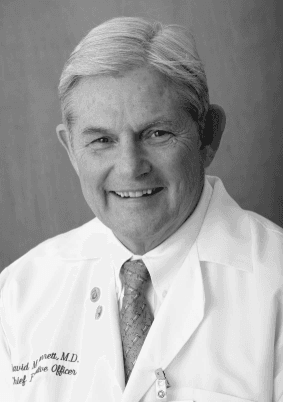
In Dr. David Barrett’s illustrious career, he has served as a United States Air Force Flight Surgeon during the Vietnam War, Mayo Clinic Chair of Urology, President and CEO of the Lahey Clinic, and as Clinical Professor of Surgery in the Dartmouth-Hitchcock Department of Urology.
You can only have one: Rose’s caramel corn, an ice cream cone from Jersey Junction, or a Yesterdog. Which do you choose?
Without question Rose’s caramel corn.
What was your path from East Grand Rapids to where you are now in life?
My plan was to attend Albion College and pursue a business administration degree and ultimately join my father’s manufacturing firm. As I was finishing my sophomore year at Albion my father sold the company. Wow! What do I do now? Fortuitously, I had done well in Kinesiology and became very interested in human anatomy. This was the beginning of a lifelong participation in the practice of medicine. Not only did I have a keen aptitude in mastering the medical sciences, it satisfied a personal need of wanting to serve mankind.
Medical School was next at Wayne State and following a surgical internship at Detroit Receiving Hospital I was accepted as a surgical resident at the Mayo Clinic. I was able to finish one year of a five year commitment when the needs of the USAF intervened due to the Vietnam war.
I was selected to attend the USAF School of Aerospace Medicine, where the Apollo astronauts were training. I graduated in the summer of 1970 as a USAF Flight Surgeon and Captain. I had hopes of being in the space program, but the Air Force had other ideas. After a short stint with the Strategic Bomber command I was sent to Cam Rahn Bay, Vietnam. This is a story in its own right but I returned from Vietnam in 1972 as a moved and much wiser man.
I returned to Mayo to pursue my residency and finished my specialty training in Urology.
I joined the staff at Mayo, becoming the Anson L Clark Professor and Chair of Urology in 1988. I eventually chose to leave Mayo in 1998 to become the President and CEO of the Lahey Clinic in Boston. I was their leader until 2011.
After that, I served as a Clinical Professor of Surgery in the Dartmouth-Hitchcock Department of Urology, finally leaving the active practice of medicine in 2015. Not operating and seeing patients has been difficult, but I directed my interest to several board of trustee and director positions, which I continue to pursue.
What specific thing did you learn in East that has enabled you to be successful?
I was a very insecure child upon entering Mrs Golden’s kindergarten class in 1947. I was also a marginal student until college. Most of the important lessons learned were on the athletic field from coaches and fellow players. I was fortunate to be blessed with above average athletic ability which helped give me stature with my friends, older students and adults. This definitely helped overcome my innate insecurity. Later in life I was easily able to overcome the fear of competition which I overcame on the track and fields at East. This was the beginning of developing true courage which would come later.
The students and staff at East had character. They were polite, kind and highly moral. Disagreements and misbehavior were handled appropriately. Seeing this type of culture and tradition helped me mold and define my own vision of myself, which has served me well.
What were you like in school?
I’d like to think I was well dressed and reserved but I think most would say that I was a jock, not too smart and basically a nice person. I had trouble doing the best I could in academics. My mind was focused on athletics and non-academic school activities. My best friend was Dan Miller. He was not only a good student but good in athletics. I think we developed simultaneously and were often seen together and probably defined similarly.
Did you have a favorite teacher or class?
Reed Waterman and Frank Kuta had no specific class but taught many life lessons.
Mr. Wisz in Physics and Mr. Froysland in English both had confidence that I was a “diamond in the rough”.
If you had to choose one moment in one location to serve as the signature moment of your East school experience, what would it be?
1956: In 9th grade being called to the varsity football team to be the starting defensive end.
1960: Winning and setting the regional record in the 880 yard dash.
What do you know now that you wish you’d known then?
Learn from others. Watch human behavior and learn from the good and discard that which does not fit your definition of right or wrong. True leaders have a good sense of what is the right thing to do.
Do you stay in touch with many people from East Grand Rapids?
Dan Miller, Bill George, Dick Biehn, George Andrews, Dave Frey, Fred Vogt, Kent Dickinson, George Maentz, John Frey
What advice do you have for young East alums who are just starting out?
Be prepared for change. CHANGE is one of the laws of life. In many ways, how you deal with change in your life will define how successful you will be. (Read “Who Moved My Cheese” by Spencer Johnson)
Who else would you like us to have a virtual cup of coffee with?
Mr. John Frey, Frey Foundation
Bonus question: What are you glad we didn’t ask you about?
Who was responsible for putting the VW bug on the library roof on senior skip day in 1960.