

Here’s a problem: Your “smart” Google Nest thermostat doesn’t light up. You press the button and nothing happens. So now you have no way to control the furnace or air conditioner. You need to turn off the circuit breaker, but, like a lot of houses, only about half your breakers are labeled, some are in illegible pencil, and a few were labeled by the previous owners with names like “Hall” or “Gladys’s room.” And since the thermostat isn’t lighting up, you don’t have any idea if you’ve turned off the right breaker.
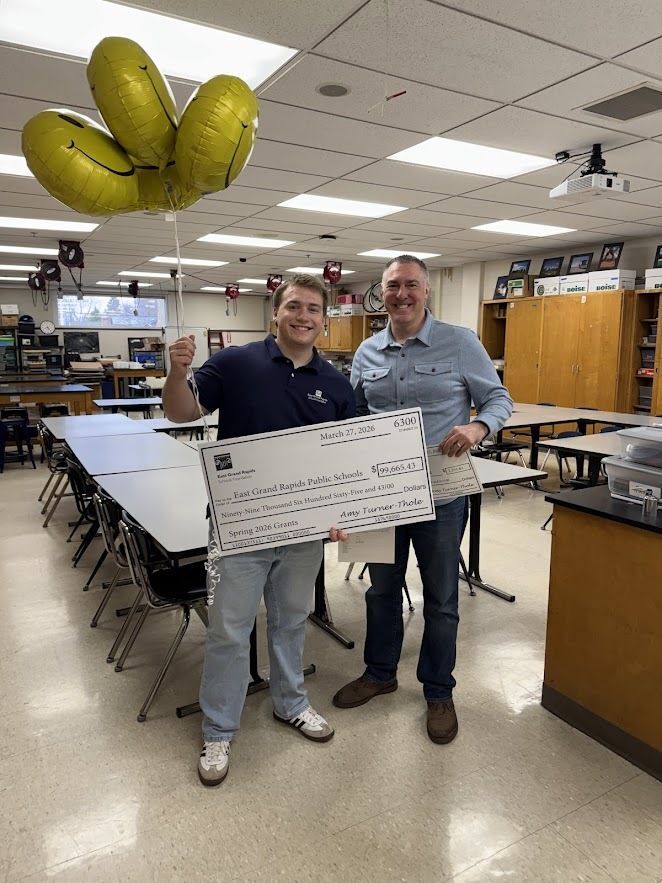
Tough one, right? Want some help with that? You could reach out to one of the EGRHS students who have benefited from the $2,351.61 Foundation-funded grant for electrical circuit kits.
“Within our current physics first (9th grade science) curriculum we teach a series of units around electric fields, electrical forces and circuits investigations,” wrote EGRHS teachers Aaron Ditty and Matt Harold in their grant application. “During these units we seek to meet the state standards below as well as teaching students some practical skills around taking measurements of an electrical system as well as building simple circuits to see how changes in the circuit affect other components in the circuit. These skills are again used in projects later in the school year such as the Wind Turbine Design project and Miniature Mini Golf Courses that require electrical features.”
Before applying for the grant, Ditty and Harold tried out the kits themselves. “The goal of this grant is to improve the quality of the equipment used to teach lessons on electricity and circuits, and therefore improve student understanding of circuits and electromagnetism,” they wrot. “The kits are designed to keep circuits organized and emphasize inquiry and discovery. The flexibility of the materials will allow teachers to work within the teaching pedagogy currently used and be more consistent with Modeling Physics with an emphasis on exploring concepts before explaining circuit calculations. The major components in the kit are well made and easy to use, and they will easily integrate with materials already in use, such as power supplies. We purchased a kit with department money to preview the materials and are happy with the quality of the components.”
Now, we know that we need to solve the non-functioning Google Nest issue. Problem is, we can’t stop wanting to build a “Miniature Mini Golf Course that require electrical features” instead. The thermostat can wait.